
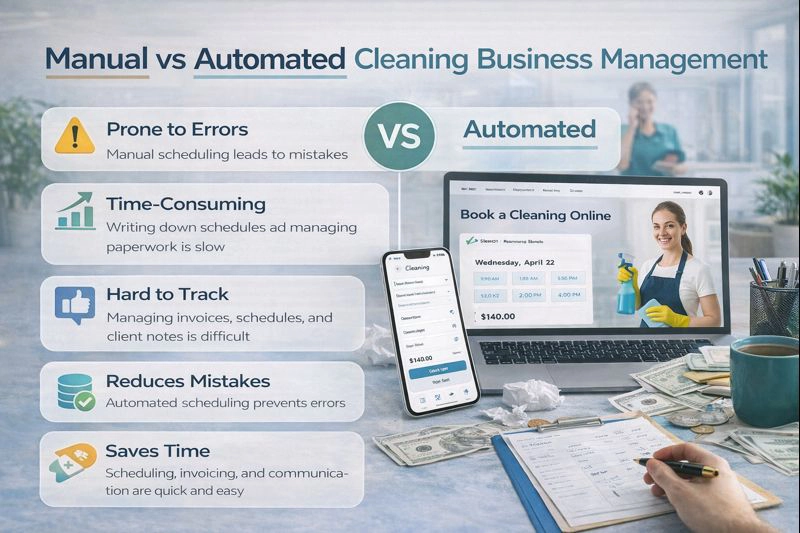
What Manual Cleaning Business Management Looks Like
Manual management usually means handling most processes by hand.
- Booking jobs via phone calls or messages
- Writing down appointments or using spreadsheets
- Manually calculating prices
- Tracking clients in multiple places
This approach relies heavily on memory and constant owner involvement.
Why Manual Systems Feel Acceptable at the Beginning
At an early stage, manual management seems flexible and inexpensive.
- Low number of clients
- Simple schedules
- Owner handles everything personally
The problems usually appear as soon as demand increases.
Problems Caused by Manual Management
As the business grows, manual systems create operational risks.
- Missed or double bookings
- Inconsistent pricing
- Lost client information
- Slow response times
- High stress for the owner
Lack of Visibility and Control
Manual management provides no clear overview.
- No centralized job list
- No real-time schedule visibility
- No clear picture of daily or weekly workload
This makes planning and delegation difficult.
What Automated Cleaning Business Management Means
Automation replaces scattered manual tasks with structured systems.
- Online booking with predefined services
- Automated pricing based on rules
- Centralized job and client management
- Clear schedules and confirmations
Automation creates consistency and reduces human error.
How Automation Improves Daily Operations
Automated systems simplify everyday work.
- Fewer manual messages and calls
- Instant booking confirmations
- Clear service scope for every job
- Less time spent on admin tasks
Automation and Client Experience
Clients benefit directly from automation.
- Clear pricing before booking
- Easy self-service booking
- Professional presentation
- Faster responses
This increases trust and booking confidence.
Beyond Management: Visibility and Lead Generation
Modern automated platforms often combine multiple functions.
- Online booking and pricing
- Mini websites for services
- Business directory listings
- Built-in lead generation
This allows cleaning businesses to attract and manage clients from one system.
Manual vs Automated: The Key Difference
The main difference is scalability.
- Manual management depends on the owner
- Automated management depends on systems
Systems allow growth without chaos.
Platforms as Operational Infrastructure
This is where industry-specific platforms come into play.
Maidbos is an example of an operational platform designed for cleaning businesses, combining booking, pricing, client visibility, and service presentation into one system.
Instead of managing chaos, the business operates on processes that scale.
Conclusion
Manual cleaning business management limits growth, increases stress, and leads to operational mistakes. Automated systems provide structure, consistency, and scalability. For cleaning businesses in the USA, automation is not about replacing people — it is about building a business that can grow without losing control.