
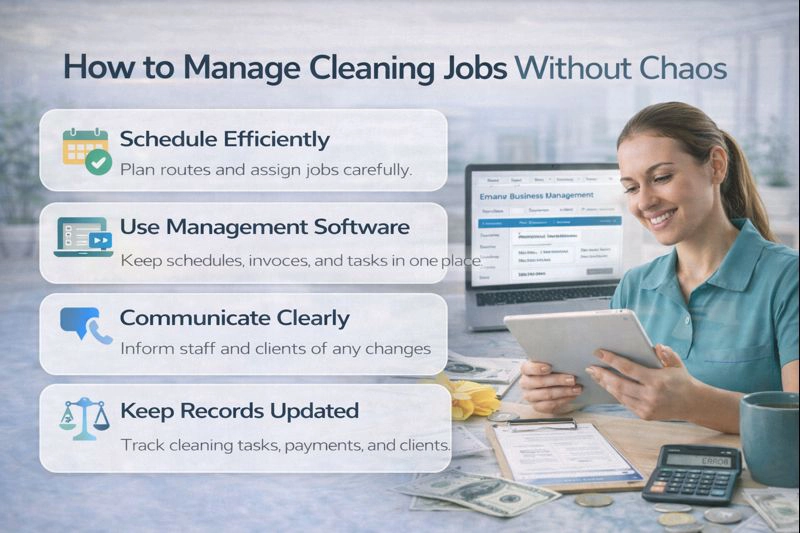
Chaos Is a Symptom, Not the Root Problem
Most cleaning business owners feel overwhelmed not because they lack effort, but because information is scattered.
When jobs, clients, prices, and schedules live in different places, confusion becomes inevitable.
What Chaos Looks Like in Daily Operations
Operational chaos usually shows up in familiar ways.
- Double bookings or forgotten jobs
- Unclear service scope for staff
- Last-minute changes handled manually
- Constant messages asking for clarification
Each issue may seem small, but together they drain time and focus.
Why Manual Coordination Breaks Down
Manual coordination relies heavily on memory and availability.
- Details are stored in chats or notes
- No single source of truth
- Decisions depend on one person
As job volume increases, this approach stops working.
The Importance of a Central Job View
Managing jobs becomes easier when everything is visible in one place.
- Upcoming jobs and schedules
- Service details and add-ons
- Client information
- Assigned staff or teams
Without a central view, planning is reactive instead of proactive.
Clear Service Structure Reduces Questions
Many daily problems come from unclear service definitions.
- Staff unsure what is included
- Clients expecting extra work
- Disputes after the job
Structured services and clear options reduce confusion for everyone.
Why Systems Reduce Daily Decision-Making
Chaos grows when every job requires manual decisions.
Systems reduce this by:
- Standardizing services
- Applying consistent pricing logic
- Automating confirmations and details
This removes hundreds of small decisions from the owner’s day.
From Managing Jobs to Managing a Process
Successful cleaning businesses stop managing individual jobs.
Instead, they manage a repeatable process:
- Client discovers service
- Client sees price and options
- Booking is confirmed
- Job details are clear for staff
When the process is clear, jobs run smoothly.
Why Platforms Are Used to Reduce Operational Chaos
This is why many cleaning businesses adopt industry-specific platforms.
Maidbos is an example of a platform that brings bookings, pricing, job details, and service presentation into one structured system.
Instead of coordinating everything manually, businesses operate from a single source of truth that keeps jobs organized and predictable.
Control Comes from Structure
Chaos is not solved by working harder.
It is solved by creating structure that allows the business to run consistently, even as volume increases.
Conclusion
Managing cleaning jobs without chaos requires more than effort — it requires systems. By centralizing information, standardizing services, and using structured platforms, cleaning businesses in the USA can regain control, reduce stress, and operate smoothly as they grow.